
Padmaja Ayurveda Clinic offers personalized Ayurvedic piles treatment in Vijayawada, focusing on symptom management, digestive health, bowel regularity, diet, lifestyle and individualized care.
Piles, also known as hemorrhoids, are a common condition that can affect people of all ages. They occur when the veins in the lower rectum or around the anus become swollen and inflamed, leading to symptoms such as bleeding during bowel movements, itching, discomfort, swelling, or pain. While piles are not usually life-threatening, they can significantly affect daily comfort, confidence and quality of life. Many individuals hesitate to seek treatment because of embarrassment or the misconception that piles will resolve on their own. However, persistent symptoms should not be ignored. Early evaluation may help identify contributing factors and support better management of the condition. At Padmaja Ayurveda Clinic, we provide best Ayurvedic Piles Treatment in Vijayawada with a focus on digestive health, lifestyle modification, and holistic wellness. Ayurveda approaches piles, known as Arsha, by understanding the underlying imbalances that may contribute to symptoms rather than focusing only on symptom management.
Whether you are experiencing bleeding piles, anal itching, discomfort while sitting, or recurrent constipation, our team aims to help you explore individualized Ayurvedic care options tailored to your needs.
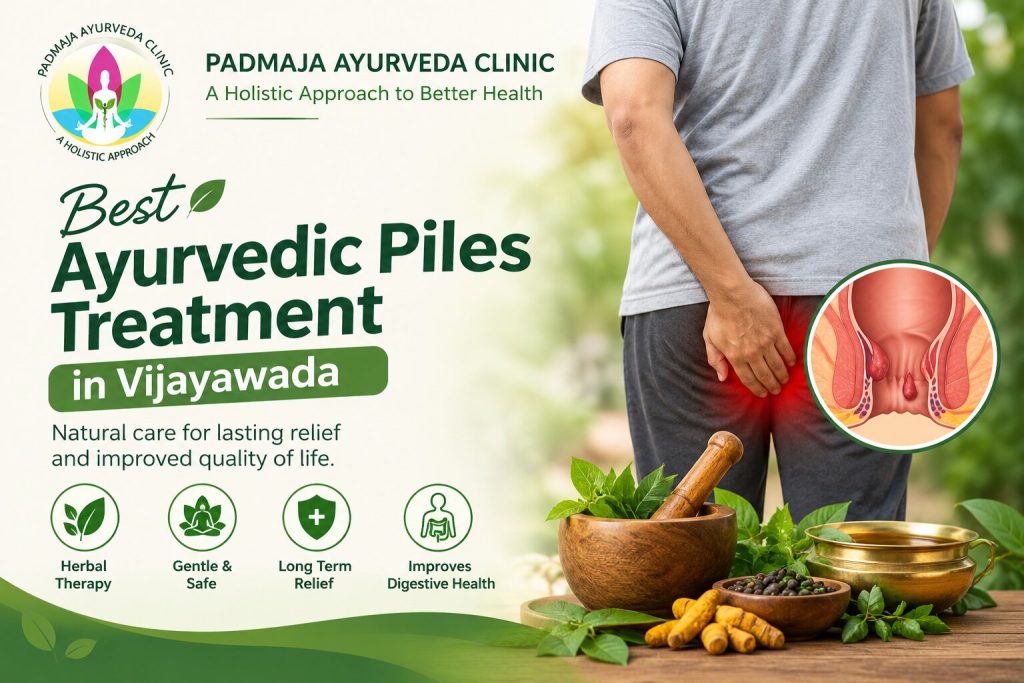
Piles or hemorrhoids, are swollen blood vessels that develop in and around the lower rectum and anus. They occur when veins in this area become stretched or inflamed, often due to straining, constipation or prolonged sitting. Piles can be internal or external and commonly cause bleeding, itching, discomfort and swelling.
Understanding Piles:
Piles develop when the cushions of tissue and blood vessels lining the anal canal become swollen or engorged. Everyone has these vascular cushions naturally; they help with continence and normal bowel control. Problems arise when repeated pressure, from straining, constipation, prolonged sitting, or pregnancy, causes these vessels to stretch, weaken, and become inflamed. Once this happens, the tissue can protrude, bleed, or become irritated during and after bowel movements. Left unaddressed, this cycle of pressure and inflammation tends to repeat and worsen over time.
Difference Between Piles and Hemorrhoids:
This is a very common question, and the answer is simple: piles and hemorrhoids refer to the same medical condition. “Hemorrhoids” is the clinical term used in medical literature, while “piles” is the more commonly used everyday term in India and several other countries. There is no difference in the underlying condition, symptoms, or treatment approach between the two terms.
How Common Are Hemorrhoids?
Hemorrhoids are extremely common, affecting people of all ages, though they become more frequent with age, during pregnancy and among people with chronic constipation or sedentary work routines. Many people experience mild symptoms at some point in their life without ever seeking treatment, which is one reason the condition is often under-reported and under-treated until it becomes more advanced.
If you are looking for Ayurvedic piles treatment in Vijayawada, a personalized consultation can help assess your symptoms and determine suitable care options. At Padmaja Ayurveda Clinic, we specialize in offering natural, effective, and non-invasive treatments for piles (hemorrhoids). If you are struggling with pain, swelling, itching, or bleeding due to hemorrhoids, Ayurvedic medicine provides safe, lasting solutions that not only address the symptoms but also target the root causes of the condition.
Understanding the different types of piles can help you recognize your symptoms and understand why treatment may vary from one person to another. Hemorrhoids are generally classified as internal piles, external piles, prolapsed hemorrhoids and thrombosed hemorrhoids based on their location and presentation. The type and severity of piles can influence the symptoms you experience and the type of medical or Ayurvedic care that may be appropriate.
Internal Piles
Internal piles, also called internal hemorrhoids, develop inside the rectum above the anal opening. They may not cause pain in the early stages because the area has fewer pain-sensitive nerves. One of the most common symptoms of internal hemorrhoids is bright red bleeding during or after bowel movements. As internal piles become more advanced, they may prolapse and extend through the anal opening, particularly during straining.
Common signs may include:
Bright red bleeding during bowel movements
A feeling of pressure or fullness
Mucus discharge
Tissue protruding from the anus
A sensation of incomplete bowel emptying
Persistent rectal bleeding should not automatically be assumed to be piles. A healthcare professional should evaluate unexplained or recurring bleeding.
External Piles
External piles develop under the skin around the anus. Because this area contains more pain-sensitive nerves, external hemorrhoids may cause symptoms such as pain, itching, swelling, tenderness, and irritation. Discomfort may become more noticeable while sitting, walking, or passing stool. External piles can sometimes become thrombosed when a blood clot forms within the swollen vein, which may result in sudden and significant pain. If you notice a painful lump or sudden swelling around the anus, professional evaluation can help determine whether it is an external hemorrhoid or another condition.
Prolapsed Hemorrhoids
Prolapsed hemorrhoids occur when an internal hemorrhoid extends through the anal opening. Prolapse may initially occur during bowel movements or straining and may return inside on its own.
Depending on the severity, a prolapsed hemorrhoid may cause:
A visible or palpable lump
Discomfort or irritation
Mucus discharge
Bleeding
A feeling of incomplete bowel emptying
Persistent or non-reducible prolapse requires medical assessment to determine the appropriate treatment approach.
Thrombosed Hemorrhoids
A thrombosed hemorrhoid occurs when a blood clot forms within an external hemorrhoid. It may appear as a firm or painful lump near the anus and can cause sudden pain, swelling, tenderness, and discomfort.
Because severe or sudden anal pain can have several possible causes, prompt medical evaluation is advisable rather than relying on self-diagnosis. Treatment depends on the individual presentation and timing.
Internal hemorrhoids are commonly classified into four grades according to the degree of prolapse. Understanding the grade of piles can help healthcare professionals determine the appropriate management approach.
Grade 1 Piles:
Grade 1 hemorrhoids remain inside the rectum and do not prolapse outside the anus. They may cause symptoms such as bright red bleeding during bowel movements but are often not externally visible.
Grade 2 Piles:
Grade 2 hemorrhoids prolapse during bowel movements or straining but return inside the rectum naturally after the bowel movement. Symptoms may include bleeding, irritation, mucus discharge, or a sensation of fullness.
Grade 3 Piles:
Grade 3 hemorrhoids prolapse during bowel movements and do not return inside automatically. They may need to be gently pushed back into the rectum. Because Grade 3 piles involve persistent prolapse, professional evaluation is important when symptoms occur.
Grade 4 Piles:
Grade 4 hemorrhoids remain permanently prolapsed and cannot be pushed back inside. They may cause ongoing discomfort, irritation, bleeding, or other symptoms.
Advanced or persistent hemorrhoids should be evaluated by a qualified healthcare professional to determine whether Ayurvedic care, medical treatment, a procedure, or surgical evaluation may be appropriate.
Which Type or Grade of Piles Do You Have?
Symptoms alone cannot always determine the type or grade of piles. Bleeding, pain, swelling, or a lump around the anus can also occur with conditions such as anal fissures and other anorectal problems.
At Padmaja Ayurveda Clinic in Vijayawada, an individualized consultation helps assess your symptoms, bowel habits, digestive health and overall condition before recommending suitable Ayurvedic care. If your symptoms require further medical or surgical assessment, appropriate referral may also be considered.
The symptoms of piles can vary depending on whether the hemorrhoids are internal or external and how advanced they are. Some people may notice only occasional bleeding or itching, while others may experience pain, swelling, a lump or discomfort during bowel movements. Recognizing the early signs of piles can help you seek appropriate evaluation and understand whether your symptoms may be related to hemorrhoids or another anorectal condition.
Bleeding During Bowel Movements:
Rectal bleeding is one of the common symptoms of internal piles. It may appear as bright red blood:
On toilet paper after wiping
On the surface of the stool
In the toilet bowl after passing stool
Although hemorrhoids can cause rectal bleeding, persistent or unexplained bleeding should be evaluated by a healthcare professional rather than assumed to be piles.
Anal Itching and Irritation:
Anal itching can occur with piles and may be associated with irritation around the anus. Mucus discharge, inflammation, or difficulty keeping the area clean may contribute to itching and discomfort. If itching is persistent or accompanied by bleeding, swelling, or pain, an appropriate evaluation can help identify the underlying cause.
Burning Sensation Around the Anus:
Some people with hemorrhoids experience a burning sensation around the anus, particularly after passing stool. Irritation may become more noticeable with constipation, frequent straining or prolonged sitting. Persistent burning should be assessed because anal fissures and other anorectal conditions can cause similar symptoms.
Swelling Around the Anus:
Swelling around the anus may occur with external or prolapsed hemorrhoids. You may notice that the swelling:
Appears or becomes more noticeable after straining
Causes tenderness or irritation
Makes sitting uncomfortable
Changes in size or sensitivity over time
Sudden or painful swelling may require prompt medical assessment.
Lump or Bulge Near the Anus:
A lump near the anus may be associated with an external hemorrhoid or a prolapsed internal hemorrhoid. Some people describe it as a soft swelling, tender bump, or feeling of fullness. Not every lump around the anus is caused by piles, so a proper examination is important when the lump is persistent, painful or changing.
Pain or Discomfort While Sitting:
Pain is more commonly associated with external piles, thrombosed hemorrhoids or significantly irritated prolapsed hemorrhoids. Discomfort may become more noticeable when sitting for long periods or during bowel movements. Sudden or severe anal pain should be medically evaluated to determine the cause.
Mucus Discharge:
Some people with prolapsed hemorrhoids may notice mucus discharge after bowel movements. Mucus can contribute to moisture, itching and irritation around the anal area. If mucus discharge is persistent or occurs with bleeding, pain or changes in bowel habits, professional evaluation is recommended.
Feeling of Incomplete Bowel Emptying:
Larger or prolapsed hemorrhoids may sometimes create a feeling of incomplete bowel emptying. This sensation can encourage repeated straining or longer toilet visits, which may further irritate the anal area. Addressing constipation and avoiding excessive straining are important parts of maintaining healthy bowel habits.
Experiencing These Piles Symptoms?
If you are experiencing bleeding, itching, burning, swelling, pain or a lump around the anus, do not rely on self-diagnosis. Similar symptoms can occur with anal fissures and other anorectal conditions.
At Padmaja Ayurveda Clinic in Vijayawada, an individualized consultation can help assess your symptoms, bowel habits, digestive health, and lifestyle before appropriate Ayurvedic care is considered.
Book a consultation to discuss your piles symptoms and explore personalized care options in Vijayawada.
Piles, or hemorrhoids, develop when increased pressure affects the blood vessels and supporting tissues in and around the lower rectum and anus. Constipation, repeated straining, hard stools, prolonged sitting, pregnancy, and other factors can increase pressure in this area and contribute to hemorrhoid symptoms.
Understanding the causes of piles can help you identify habits and health factors that may be contributing to recurring symptoms. However, the exact cause can vary from person to person.
Common Causes of Piles:
Several factors may increase the likelihood of developing piles or hemorrhoids:
In Ayurveda, piles are traditionally described as Arsha. Classical Ayurvedic literature discusses Arsha in relation to digestion, bowel habits, diet, lifestyle, and the balance of the doshas. Ayurvedic assessment therefore looks beyond the local symptoms and considers the individual’s overall digestive and bowel health.
For people searching for Ayurvedic piles treatment in Vijayawada, understanding how Ayurveda approaches Arsha can provide useful context about the principles behind personalized care.
What Is Arsha in Ayurveda?
Arsha is the Ayurvedic term traditionally used for piles or hemorrhoids. Ayurvedic texts describe Arsha as a condition associated with the anal and rectal region and discuss different presentations based on factors such as dosha involvement, digestion, bowel habits, and individual constitution. In Ayurvedic practice, understanding the patient’s Prakriti, diet, digestion, bowel movements, lifestyle, and symptoms may form part of the overall assessment before an individualized care plan is considered.
Ayurvedic Understanding of Piles:
Ayurveda traditionally connects Arsha with digestive function and elimination. Factors such as irregular eating habits, constipation, unsuitable dietary patterns, and irregular bowel movements are considered relevant when assessing the condition. Ayurvedic assessment may consider the role of Vata, Pitta, and Kapha, along with concepts such as Agni and Ama, to understand an individual’s symptom pattern. This traditional framework differs from the modern medical understanding of hemorrhoids. Modern medicine generally describes piles as swollen or enlarged hemorrhoidal blood vessels and supporting tissues, while Ayurveda interprets the condition through its own classical principles.
Role of Vata Dosha in Arsha:
In Ayurvedic philosophy, Vata Dosha is associated with movement and elimination. An imbalance in Vata is traditionally associated with dryness, irregular bowel movements, constipation, and difficulty passing stool. Because repeated straining and hard stools can contribute to hemorrhoid symptoms, Ayurvedic management may place particular attention on maintaining comfortable and regular bowel movements.
Role of Pitta Dosha in Arsha:
Pitta Dosha is traditionally associated with heat and metabolic processes. In Ayurvedic descriptions, Pitta involvement may be considered when symptoms include sensations such as burning, irritation, or bleeding.
The specific Ayurvedic interpretation depends on the individual’s overall symptoms and assessment rather than a single symptom alone.
Role of Kapha Dosha in Arsha:
Kapha Dosha is traditionally associated with stability, structure, and lubrication. Ayurvedic assessment may consider Kapha involvement when symptoms include swelling, heaviness, or mucus-related concerns. A practitioner considers the complete symptom pattern rather than assigning a dosha based on one symptom.
Importance of Agni in Ayurvedic Piles Care:
Agni, traditionally described as digestive fire, is an important concept in Ayurveda. Ayurvedic practice considers healthy digestion and regular elimination important aspects of maintaining overall digestive wellness.
For individuals with piles and constipation, Ayurvedic care may therefore include dietary and lifestyle recommendations intended to support comfortable digestion and regular bowel habits.
Understanding Ama in Ayurveda:
Ama is a traditional Ayurvedic concept generally described as material associated with impaired digestion. It is used within Ayurvedic theory to explain certain patterns of digestive imbalance. Recommendations related to Ama are traditionally individualized according to the person’s digestive status, diet, lifestyle, and overall Ayurvedic assessment. These concepts should be understood within the traditional Ayurvedic framework rather than as direct biomedical explanations for hemorrhoids.
Ayurvedic Approach to Arsha:
Ayurvedic management of Arsha generally takes an individualized approach rather than following the same protocol for every patient. The assessment may consider:
Digestive health and bowel regularity
Constipation and straining
Dietary habits
Lifestyle and daily routine
Prakriti and dosha considerations
Type and severity of symptoms
Overall health and individual suitability
This approach can help guide dietary recommendations, lifestyle measures, herbal support, and other Ayurvedic therapies when appropriate.
Can Ayurveda Help Manage Piles?
Ayurvedic care may help support the management of piles by addressing bowel habits, constipation, digestive health, diet, lifestyle, and individual Ayurvedic factors. Depending on the person’s condition and suitability, an Ayurvedic practitioner may consider dietary guidance, lifestyle measures, herbal support, or selected traditional therapies.
However, Ayurvedic treatment should not replace appropriate medical evaluation when symptoms are severe, persistent, recurrent, or unusual. Rectal bleeding should not automatically be assumed to be caused by piles, and advanced prolapsed or thrombosed hemorrhoids may require medical or surgical assessment.
At Padmaja Ayurveda Clinic in Vijayawada, piles consultations are individualized according to the patient’s symptoms, digestive and bowel history, lifestyle and Ayurvedic assessment. The aim is to provide appropriate care while recognizing when further medical evaluation may be needed.
Looking for Ayurvedic piles treatment in Vijayawada? Schedule a consultation at Padmaja Ayurveda Clinic to discuss your symptoms and explore suitable care options.
At Padmaja Ayurveda Clinic, we provide personalized Ayurvedic care for piles and hemorrhoids based on your symptoms, bowel habits, digestive health, lifestyle and individual Ayurvedic assessment. Since every patient’s condition can be different, treatment recommendations are tailored rather than based on a fixed protocol.
Our approach to Ayurvedic piles treatment in Vijayawada may include:
Diet Recommendations for Piles
Lifestyle Tips to Help Prevent Recurrence
Alongside diet, certain lifestyle habits play an important role in preventing piles from recurring or worsening:
Small, consistent changes in daily routine often make a meaningful long-term difference in reducing recurrence.
Choosing Ayurvedic piles treatment can provide an individualized approach that considers your symptoms, digestive health, bowel habits, diet, lifestyle, and overall Ayurvedic assessment. At Padmaja Ayurveda Clinic, the focus is on supporting comfortable bowel movements and managing piles symptoms through personalized care.
Padmaja Ayurveda Clinic is conveniently located to serve patients across Vijayawada. Piles and hemorrhoid-related concerns are common across all age groups in our region, often linked to dietary patterns, long work hours and sedentary routines typical of urban life. We regularly see patients travel to our clinic from across Vijayawada and nearby localities including Benz Circle, Gunadala, Poranki, Tadigadapa, Gannavaram, Penamaluru, Mangalagiri, and Kankipadu, seeking a non-surgical, personalized approach to managing piles and related digestive concerns.
If you are based in Vijayawada or any of these nearby areas and are looking for accessible, experienced local healthcare support for piles, our clinic offers a convenient option combining traditional Ayurvedic principles with a patient-centered consultation process.
Choosing the right clinic matters when you are dealing with piles, hemorrhoids, bleeding, constipation, or other sensitive anorectal concerns. At Padmaja Ayurveda Clinic in Vijayawada, our approach focuses on understanding your individual symptoms and providing Ayurvedic care based on your specific needs.
Book Your Piles Consultation in Vijayawada
If you are experiencing bleeding during bowel movements, anal itching, swelling, pain, constipation, or a lump around the anus, do not rely on self-diagnosis. A proper assessment can help identify the cause of your symptoms and guide appropriate care.
Contact Padmaja Ayurveda Clinic in Vijayawada to schedule a personalized consultation for piles and hemorrhoids.
The healing time depends on the severity of the condition. For mild cases, relief can be experienced within 2-4 weeks, while chronic cases may take 6-8 weeks for complete healing.
Yes, we recommend avoiding foods that contribute to constipation, such as processed foods, red meat, and dairy. A high-fiber diet is essential to ensure regular bowel movements.
Yes, Ayurvedic treatments are effective for both mild and severe piles, as they focus on healing the root cause (digestive issues) and improving overall health.
info@padmajaayurvedaclinic.com
