
Get Ayurvedic sciatica treatment in Vijayawada for Gridhrasi, lower back pain and leg pain with assessment-based care at Padmaja Ayurveda Clinic.
Sciatica can cause pain that travels from the lower back or buttock into the leg, making sitting, walking, standing or everyday movement uncomfortable. Some people may also experience tingling, numbness, burning sensations or shooting pain along the affected leg. The symptoms and their underlying causes can vary from person to person.
In Ayurveda, symptoms that resemble sciatica are traditionally discussed under the concept of Gridhrasi. Ayurvedic care focuses on understanding the individual’s symptoms, health history, physical condition and relevant Ayurvedic factors before recommending treatment.
At Padmaja Ayurveda Clinic in Vijayawada, Dr. D. Padmaja provides Ayurvedic clinical care with an emphasis on appropriate assessment and individualized treatment planning. If you are looking for Ayurvedic sciatica treatment in Vijayawada, a consultation can help determine whether Ayurvedic management is appropriate for your condition. we offer effective, non-surgical solutions for sciatica.Our Ayurvedic treatments are focused on healing the root cause, relieving nerve compression, reducing inflammation and restoring mobility.
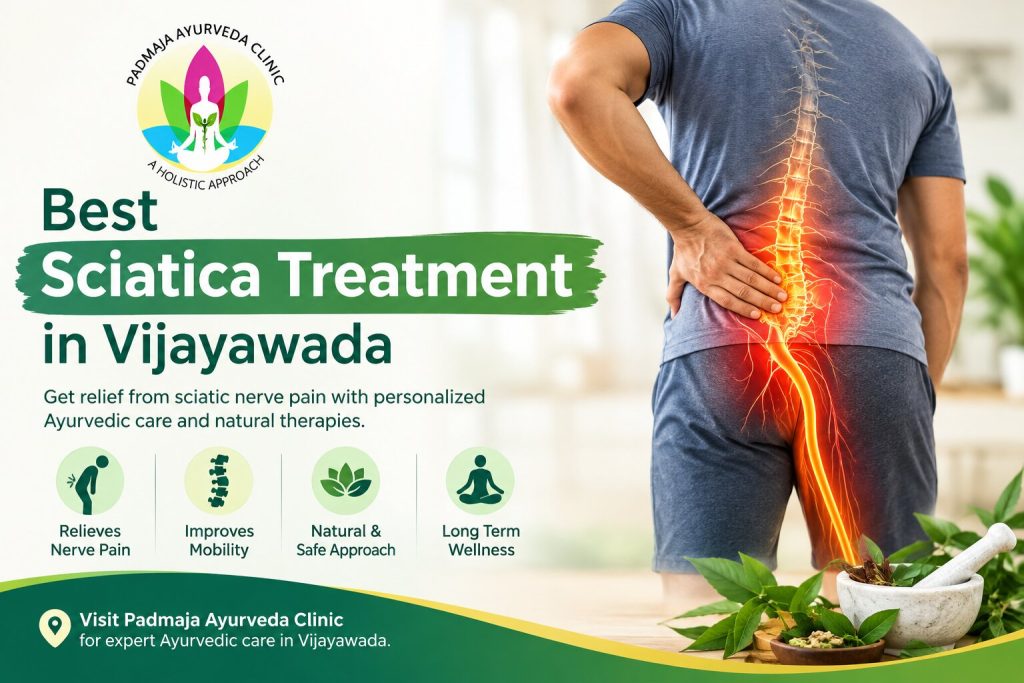
Sciatica describes pain that travels along the path of the sciatic nerve, which runs from the lower back through the buttocks and down the leg. It commonly affects one side and may be felt mainly in the buttock, back of the thigh, calf or foot. Symptoms can range from an ache to sharp, burning or shooting pain. Tingling, numbness or weakness may also occur.
Sciatica is generally a symptom pattern rather than a single disease. It can occur when nerve roots in the lower spine become irritated or compressed. Disc-related problems are a common cause, while other spinal changes can also contribute.
Sciatica can cause pain and other sensations that travel from the lower back or buttock into the leg. Symptoms may affect the thigh, calf, or foot and can vary depending on the underlying cause. If you are experiencing persistent sciatica leg pain, tingling, numbness, or difficulty with movement, an appropriate assessment can help understand your symptoms and guide suitable care.
Common Symptoms of Sciatica
Sciatica symptoms may include:
Not everyone experiences the same symptoms. The location, intensity, and duration of sciatic nerve pain can vary depending on the underlying condition.
When Should You Consider an Ayurvedic Consultation?
Persistent lower back pain, radiating leg pain, or sciatica symptoms can affect sitting, walking, standing, sleeping, and other daily activities. If these symptoms continue or repeatedly return, an Ayurvedic consultation can help assess your condition and determine whether Ayurvedic sciatica treatment is appropriate.
At Padmaja Ayurveda Clinic in Vijayawada, Dr. D. Padmaja, M.D. (Ay), Ph.D., provides Ayurvedic clinical care based on individual assessment and treatment planning. Symptoms resembling sciatica are traditionally discussed in Ayurveda under Gridhrasi, and the appropriate approach depends on the individual’s condition.
If you are looking for Ayurvedic sciatica treatment in Vijayawada, schedule a consultation to discuss your symptoms and suitable Ayurvedic care.
In Ayurveda, a condition known as Gridhrasi is traditionally described with symptoms that can resemble the pattern of sciatica. Ayurvedic literature describes pain that may extend from the lower back or buttock region toward the lower limb, along with stiffness and difficulty in movement.
Gridhrasi is discussed within the Ayurvedic framework of Vata disorders. Some Ayurvedic descriptions also discuss Vata and Kapha involvement depending on the presentation.
It is important to understand that Gridhrasi is an Ayurvedic clinical concept that can resemble the symptom pattern of modern sciatica. The two terms should not simply be treated as interchangeable diagnoses. Modern medicine evaluates sciatica in relation to structures such as spinal nerve roots, discs, and the nervous system, while Ayurveda approaches Gridhrasi through its own traditional diagnostic and therapeutic framework.
This distinction allows patients to understand both perspectives without confusing traditional Ayurvedic concepts with modern anatomical diagnoses.
Ayurvedic management of sciatica-like symptoms begins with understanding the individual’s symptoms, health history, and overall condition. Since the pattern and severity of sciatica pain can vary, the right Ayurvedic approach may differ for each patient.
At Padmaja Ayurveda Clinic in Vijayawada, Ayurvedic treatment planning may consider:
Location and nature of pain
Duration and recurrence of symptoms
Lower back and leg discomfort
Tingling or numbness
Relevant health history
Functional difficulties
Ayurvedic assessment
Lifestyle and daily activity patterns
Overall health condition
Based on the assessment, the Ayurvedic physician can determine whether Ayurvedic treatment for sciatica is appropriate and recommend suitable care. Depending on the individual’s condition, this may include applicable Ayurvedic therapies, medicines, lifestyle guidance, or supportive measures.
The focus is on understanding each patient’s presentation before recommending care rather than applying the same approach to every case of sciatica or sciatica leg pain.
In Ayurveda, symptoms resembling sciatica are traditionally discussed under Gridhrasi. Published literature has examined Ayurvedic approaches for Gridhrasi, including Panchakarma-based protocols, but available evidence varies in quality and treatment methods. Patients considering Ayurvedic sciatica treatment in Vijayawada should therefore discuss their symptoms and treatment suitability with a qualified Ayurvedic physician.
Ayurvedic care for Gridhrasi and sciatica-like symptoms may involve different therapeutic approaches based on the individual’s assessment. Panchakarma is an important area of Ayurvedic practice, and Ayurvedic literature has discussed Panchakarma-based approaches for Gridhrasi.
At Padmaja Ayurveda Clinic in Vijayawada, treatment selection is guided by the patient’s symptoms, health condition, and Ayurvedic assessment rather than applying the same therapy to every patient.
Depending on clinical suitability, Ayurvedic treatment for sciatica may involve:
Specific therapies should be recommended only after assessment. Procedures such as Basti, Snehana, Swedana, Kati Basti, or other Ayurvedic therapies should not be assumed to be suitable for every patient simply because they are described in Ayurvedic literature.
For patients seeking Ayurvedic sciatica treatment in Vijayawada, professional assessment can help determine which Ayurvedic approach may be appropriate. Available clinical literature on Gridhrasi reports potential benefits from some Ayurvedic interventions, but evidence and treatment protocols vary. Discussing treatment options with a qualified Ayurvedic physician is therefore important before starting care.
Managing sciatica pain involves understanding the symptoms, their duration and pattern, possible contributing factors, and their effect on daily activities. At Padmaja Ayurveda Clinic in Vijayawada, Ayurvedic care is planned according to the individual’s presentation rather than using the same approach for every patient.
1. Ayurvedic Assessment
The physician reviews symptoms, relevant health history, and overall condition to understand the patient’s presentation.
2. Individual Treatment Planning
Suitable Ayurvedic treatment for sciatica is considered based on the assessment and individual health needs.
3. Symptom Management
Applicable Ayurvedic therapies or medicines may be considered when appropriate for the patient’s condition.
4. Lifestyle Guidance
Recommendations may address daily activity, prolonged sitting, movement, rest, and relevant dietary habits where appropriate.
5. Follow-Up
The patient’s response to care can be reviewed during follow-up, allowing the treatment approach to be adjusted when necessary.
This assessment-led approach helps patients seeking Ayurvedic sciatica treatment in Vijayawada understand their treatment options and receive care based on their individual presentation rather than a standard approach for every case.
Daily habits can influence how a person manages sciatica pain, lower back discomfort and leg symptoms. At Padmaja Ayurveda Clinic in Vijayawada, lifestyle guidance may be considered alongside Ayurvedic care according to the individual’s symptoms, health condition, and overall assessment.
Supportive habits may include:
For people with back-related symptoms, maintaining suitable activity may be helpful when appropriate, while activities that worsen symptoms should be discussed with a healthcare professional.
From an Ayurvedic perspective, diet and lifestyle guidance for sciatica may be considered according to individual factors, symptoms, digestive health, and Ayurvedic assessment. A generic diet found online may not be appropriate for every person.
If you are considering Ayurvedic treatment for sciatica in Vijayawada, professional guidance can help you understand suitable dietary and lifestyle measures alongside your treatment plan.
Padmaja Ayurveda Clinic in Vijayawada provides Ayurvedic clinical care under the guidance of Dr. D. Padmaja, M.D. (Ay), Ph.D., an Ayurvedic Physician and Panchakarma Specialist.
Dr. D. Padmaja is also an Assistant Professor at Dr. N.R.S. Government Ayurvedic Medical College, Vijayawada, combining Ayurvedic clinical practice with academic teaching.
For patients exploring Ayurvedic sciatica treatment in Vijayawada, understanding the individual condition is an important part of deciding whether Ayurvedic management is appropriate. At Padmaja Ayurveda Clinic, treatment planning may consider the patient’s symptoms, health history, Ayurvedic assessment, and individual treatment needs.
The focus is on appropriate Ayurvedic guidance rather than applying the same treatment plan to every patient. Depending on the assessment, Ayurvedic therapies, medicines, Panchakarma-based care and lifestyle guidance may be considered when clinically suitable.
If you have persistent sciatica pain, lower back discomfort, or radiating leg symptoms, discussing your condition with a qualified healthcare professional can help you understand suitable treatment options. During consultation, patients can also share relevant diagnoses, investigations, medicines, or previous treatments to support informed care planning.
Yes, in many cases. Ayurvedic therapy works at the root level, not just to suppress pain but to heal the nerve and prevent recurrence.
Not necessarily. We can work alongside your current medications and gradually reduce dependency as your condition improves.
No. Most therapies are soothing, non-invasive, and relaxing. They focus on comfort and healing.
info@padmajaayurvedaclinic.com
